
I started looking for a job on September 1, 2026. My parental leave ends on November 14, so the clock is ticking.
One thing complicates it: I’m raising my one-year-old son alone. No daycare in the plan, which means the job has to be fully remote, with hours I can bend around his routine. I can answer messages during the day, work while he naps, and do the bulk of it in the evening. What I can’t offer is eight uninterrupted hours at a laptop.
You’d think finding a flexible remote job in 2026 would be easy. Almost two months in, I can tell you it isn’t.
AI has been part of the search from the start. I set up recurring tasks in ChatGPT that send me vacancies, and I keep a spreadsheet of every application. At first I filled it in myself: company, title, date, salary, conditions, replies, rejections. Then it occurred to me that ChatGPT could just have access to the tracker. Now I finish an application, type “add this to the tracker,” and move on. I love this part. When you’re juggling a toddler, a website (Tried, Actually) and a job hunt, ten saved minutes here and there add up.
By October 21 the tracker had 253 records.
In the beginning I applied to anything that looked even vaguely right: editorial, content marketing, SEO, copywriting, AI stuff, and later even jobs outside my field where I figured my experience might somehow help. Now I’m much pickier. November is close, and I can’t afford to spend hours on an interview for a job with fixed office hours, or an evening on a cover letter just to learn that “remote” means “remote, if you live in the UK.”
ChatGPT writes my cover letters too. We’ve spent an embarrassing amount of time teaching it how I actually write, and I’m quietly proud that it no longer says “I’m incredibly excited about the opportunity to join your amazing company.” Still, I read every letter. Sometimes it’s too formal, sometimes weirdly generic, sometimes it sounds like a polite stranger doing an impression of me. I end up rewriting lines and cutting compliments.
So, yes, AI made the search easier. But after 253 applications I still had no job, and I was ready to try something new. That’s how I found rtrvr.ai.
A golden retriever that searches the internet
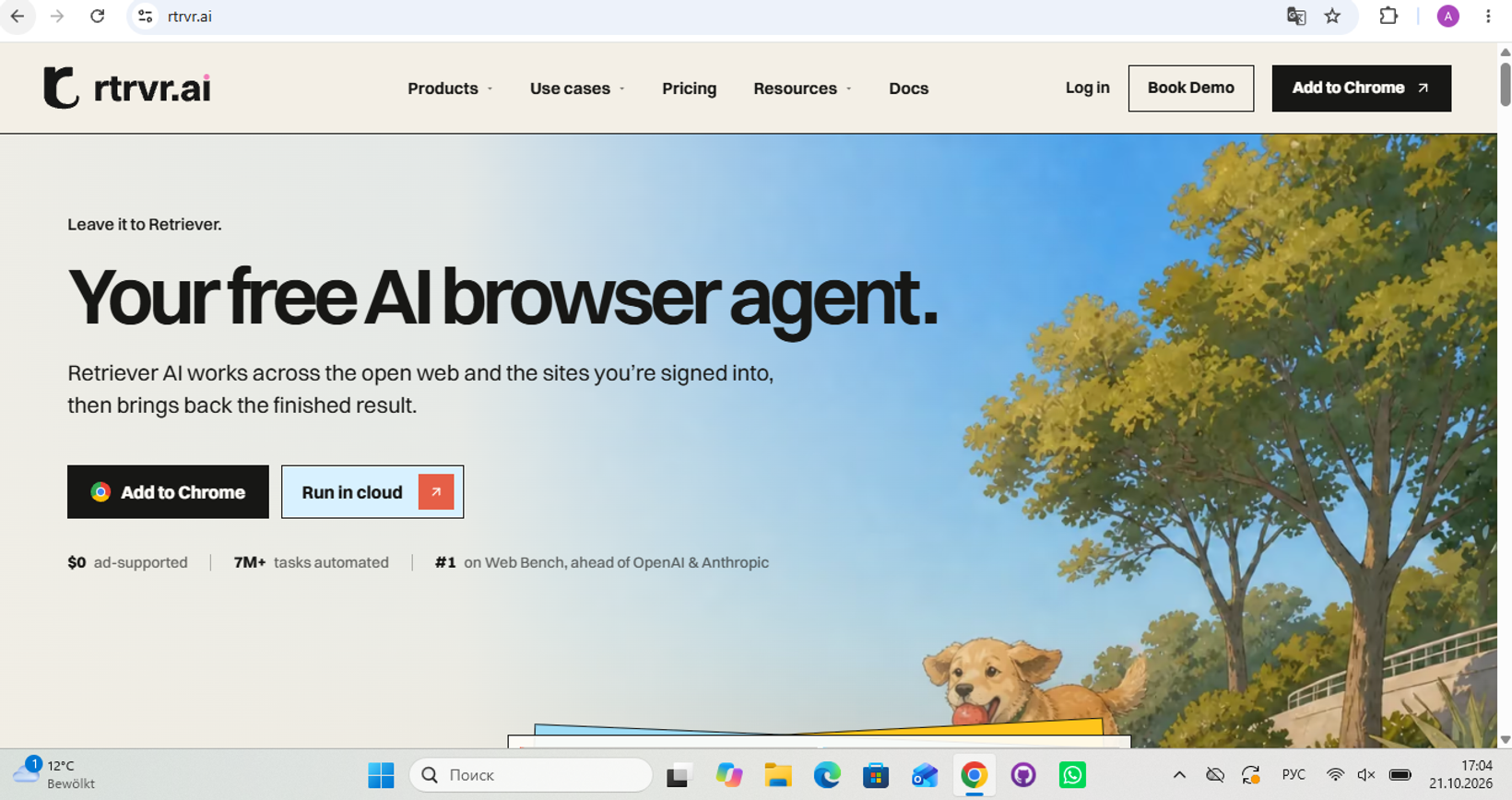
rtrvr.ai is a browser agent. You tell it what you need, and instead of handing you a list of links, it opens pages, reads them, follows links, pulls out information and puts the results together. The founders, Arjun Chintapalli and Bhavani Kalisetty, are ex-Google; the project started in 2024, and the browser agent showed up on Product Hunt that December. The free Retriever AI offering launched there on October 14, 2026.
It works as a Chrome extension or in a cloud browser. I picked the cloud version because I didn’t want to let it near my real browsing session.
Then I noticed the dog. The interface has a little pixelated golden retriever with a tennis ball. No idea whose idea that was, but I approve. A retriever goes off and fetches things, and I wanted mine to fetch a job.
I ran three experiments, giving it more and more context each time.
Attempt one: ten jobs, please
I asked it to find ten open positions that fit my background. I have about six years in editorial work, content strategy, research and marketing, including managing a team of writers, and I run Tried, Actually, where I test tech and publish in English and Russian. I wanted content, editorial or SEO roles that could be done remotely from Germany, with a decent salary and a schedule that was actually flexible.
That last point matters more than it sounds. Plenty of “fully remote” vacancies expect everyone online at set hours. Working from your living room doesn’t help if your whole day is built around meetings.
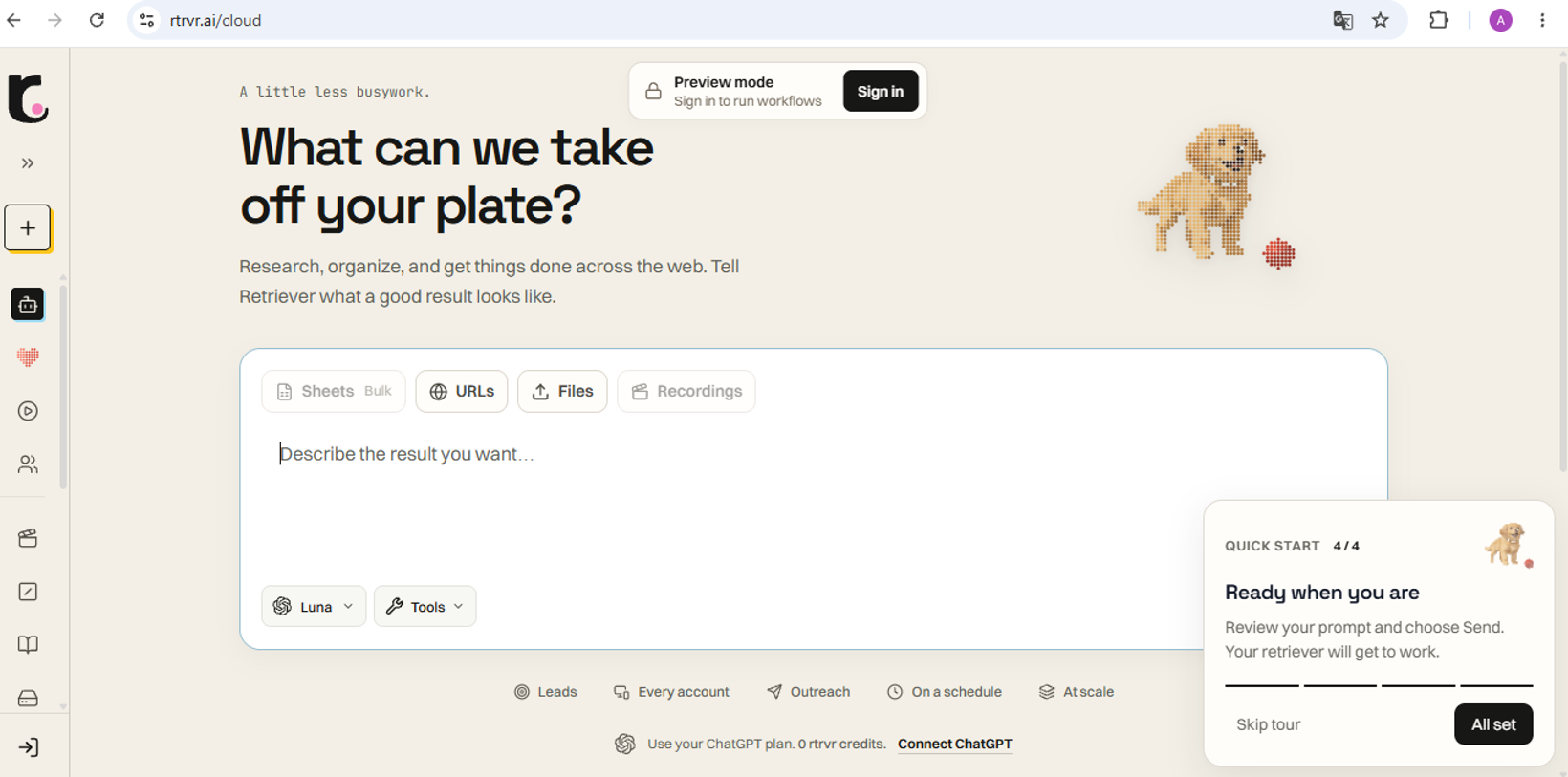
I pasted the prompt, picked the free cloud mode and hit start. The interface showed the agent’s changing reasoning text and technical activity. There was a cloud browser panel too, but I never managed to watch it click through job sites like I’d imagined. I mostly sat there watching the log change.
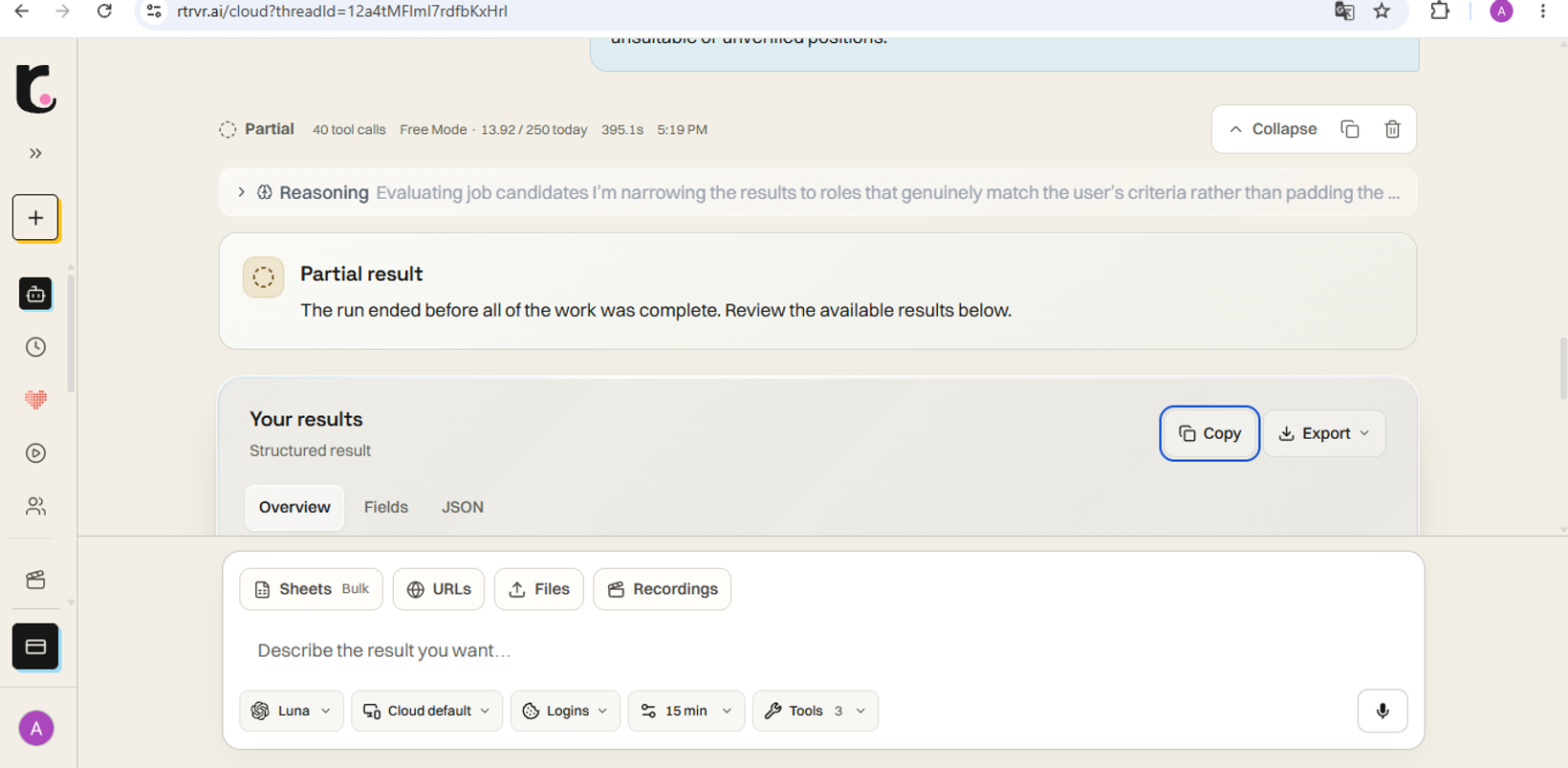
After 6 minutes 35 seconds it finished with a “Partial” status: 40 tool calls, two jobs.
The first was a Staff Technical Writer role at Grafana Labs, €85,000–€102,000 a year in Germany. I won’t pretend that number didn’t catch my eye. But the job needs deep technical documentation experience and familiarity with software systems far beyond mine. Writing about tech and testing AI tools is not the same as maintaining complex software docs.
The second was AI training work for Russian speakers at Prolific, up to $18 an hour. Russian is one of my native languages, so that part was easy. But it’s task-based with no guaranteed volume, and the rate was lower than I wanted.
Neither was useful. I was a bit let down that all that activity produced two results, though I did like that it hadn’t padded the list with eight random vacancies. It checked what it could and admitted it hadn’t finished.
Maybe the prompt was the problem, though. It knew nothing about what I’d already applied to or ruled out. So I gave it more.
Attempt two: here’s my CV, and here’s everything I’ve already tried
This time I uploaded my CV and a copy of the tracker. I removed my phone number and personal email from the CV first, and I made a separate version of the tracker. I didn’t want to connect my actual Google Drive to a service I’d just met.
The tracker had 253 records across 236 different employers, with dates, statuses, salaries and other notes going back to September.
I also changed the task. Instead of ten more vacancies, I asked the agent to look at my experience and application history and find realistic ways for me to earn a stable income. One full-time job, two part-time contracts, a mix of employment and freelance, a few regular clients, whatever worked. My target was roughly €2,000–€2,500 net a month, as long as it was reliable and compatible with looking after my son. I also nudged it to look beyond classic content jobs. I’ve done editorial management, research, marketing, operations and customer-facing work, and I speak several languages, so surely there was something I hadn’t thought of.
This run was far more interesting. It read both files and summed up my background accurately: the 7–10 writers I managed, the content strategy and publishing, my own tech site, the skills from other industries. It also went through the tracker and counted 190 entries marked Applied, 36 rejections and 11 application issues, among other outcomes. I was impressed that it really used the data instead of just saying “thanks for the files.”
Then came the opportunities. One was Head of Editorial at Finom, much closer to my experience than the technical writing job. Except Germany wasn’t on the list of countries. Another was Content Marketing Manager at 8returns, remote in Germany, but it required native-level German, and mine is somewhere around A2/B1. The agent crossed out both.
It also suggested ways to combine income sources. For example, two freelance contracts at €30/hour with ten billable hours a week each would come to about €2,600 gross a month. The maths was fine. The problem was that no actual clients came with it. I already knew two or three regular clients could work; that’s part of why I’m considering freelance at all. What I needed was help finding them.
The run finished as “Complete” after 22 tool calls. It understood me and my constraints pretty well, and I still had zero opportunities to pursue. So I got curious what would happen if I narrowed the task a lot.
Attempt three: fine, just find me three clients
For the last test I gave up on jobs entirely and asked for three companies currently looking for freelance content specialists, ideally for ongoing work. I listed what I do: editorial management, content strategy, research, writing and editing, SEO and AEO, tech journalism, localization, social media. Native Russian and Latvian, fluent English, comfortable with multilingual content. My work is available in the Tried, Actually portfolio. I wanted evidence of a real paid opportunity, something that could grow into regular monthly work. A generic careers page wouldn’t count, and neither would a company that “could probably use a writer.” It had my CV and tracker again, so it could check whether I’d already contacted anyone.
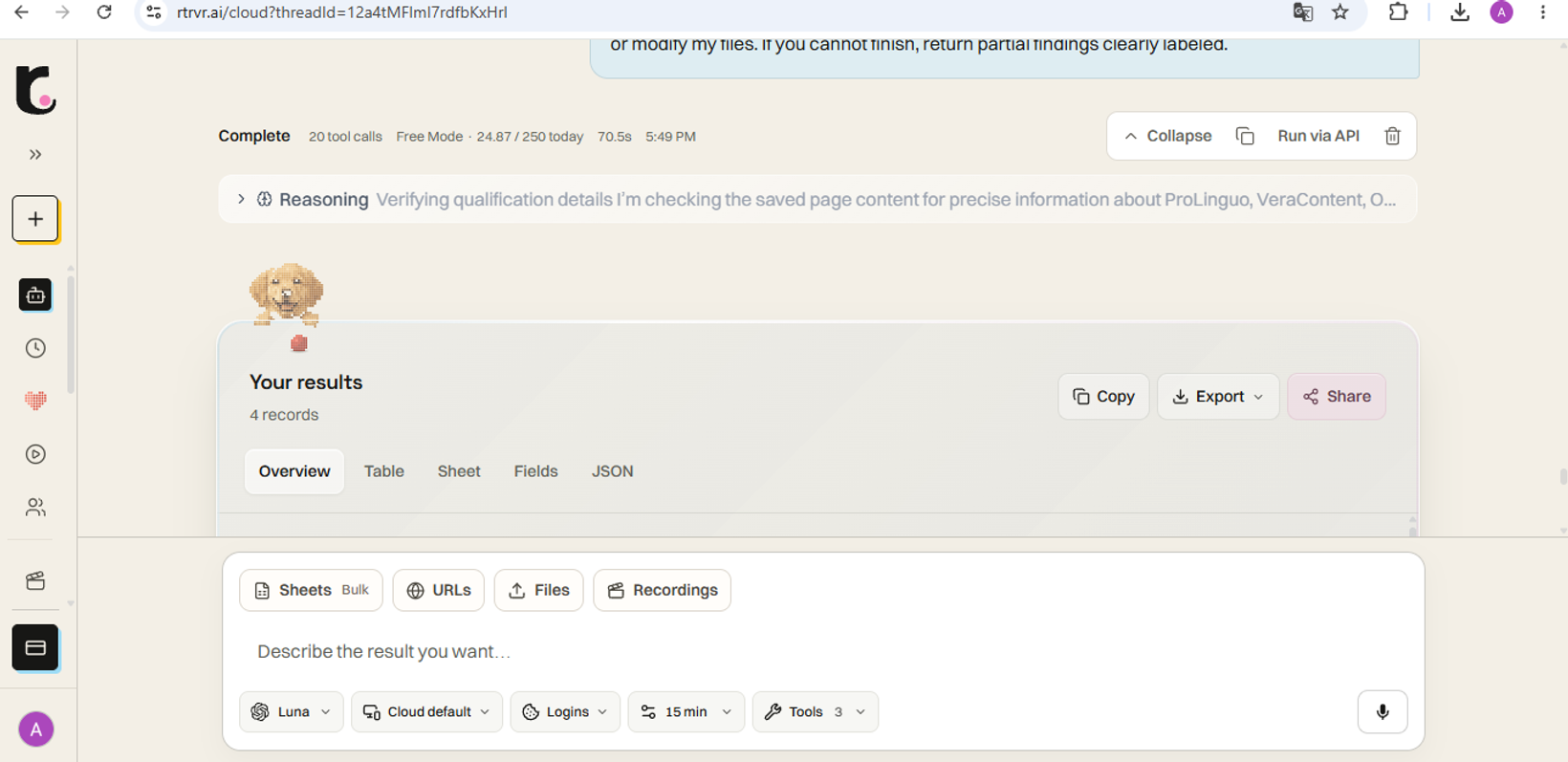
It took 70.5 seconds and 20 tool calls, and came back with four options.
VeraContent recruits freelance copywriters, translators and social media people, but the agent couldn’t find a specific current paid project or any promised workload. oneword regularly looks for freelance translators and post-editors, but nothing confirmed for my languages, no published rate, no idea how much work there’d be. ProLinguo has a page for freelance translators, but again no verifiable active project. Our World in Data had a writer vacancy, but it was an employee position, not a freelance client.
The agent ruled out all four, and I mostly agreed. I’ve met plenty of companies that are “always looking for talented freelancers,” which can mean nothing at all. You fill in a form, send your portfolio, and never hear back. Still, I laughed. I’d sent my little golden retriever to find three clients, and he came back with four explanations of why he couldn’t.
What I thought after three tests
I liked it more than the results suggest. The interface is simple, and it’s nice to hand over a research task and get a structured report without opening dozens of tabs myself. I also liked that it was careful: it checked whether jobs were available in Germany, noticed language requirements, and didn’t treat signing up to a freelancer database as landing a client.
The CV and tracker analysis in the second run was the best part. It pulled useful information out of a big application history and compared new options against what I’d already tried. I can see myself using it to check a batch of vacancies or research companies before applying.
But the first run stopped before finishing, and even the successful ones gave thin results. In the second it understood my situation and found nothing realistic. In the third it was asked for clients and returned some general freelancer recruitment pages. It was also a bit generous with match scores: the Grafana Labs job got 74/100 in the first test despite needing specialist skills I don’t have. A job can hit several keywords on my CV and still be a bad fit, and I spot that myself when I read vacancies. And while the agent was good at finding reasons to say no, I didn’t get much I couldn’t have found with my usual process.
Cost
Nothing. All three runs were in the free cloud mode. It showed sponsored content while running, and the dashboard had a daily usage allowance, which was enough for two finished tasks and one partial one.
I also kept it away from my email and Google Drive and gave it only the cleaned-up files. I’d suggest the same for anyone testing an unfamiliar AI tool. A CV already says a lot about you, and a job tracker can reveal more about your finances and situation than you’d expect.
Will I use it again?
Probably, but for something narrower. If I already have a list of companies, asking an agent to check their current vacancies and requirements could save time. I wouldn’t hand it the whole job search. My ChatGPT setup already finds vacancies, keeps the tracker and helps with applications. It’s far from perfect, and I still spend a silly amount of time checking and fixing things, but it works for me. A new tool has to either save me more time or turn up opportunities I wouldn’t find otherwise, and rtrvr.ai didn’t manage the second part.
In total it made 82 tool calls, went through my CV and 253 application records, and looked into a handful of jobs and freelance options. None of them ticked every box. My situation is pretty specific, though, and someone with ordinary working hours, different languages or a more technical background might do much better.
As for me, I keep looking. There are still a few weeks before my leave ends, and I’m hoping one of those 253 applications leads somewhere.
I did like meeting the little golden retriever. Next time I’ll give him something easier to fetch.