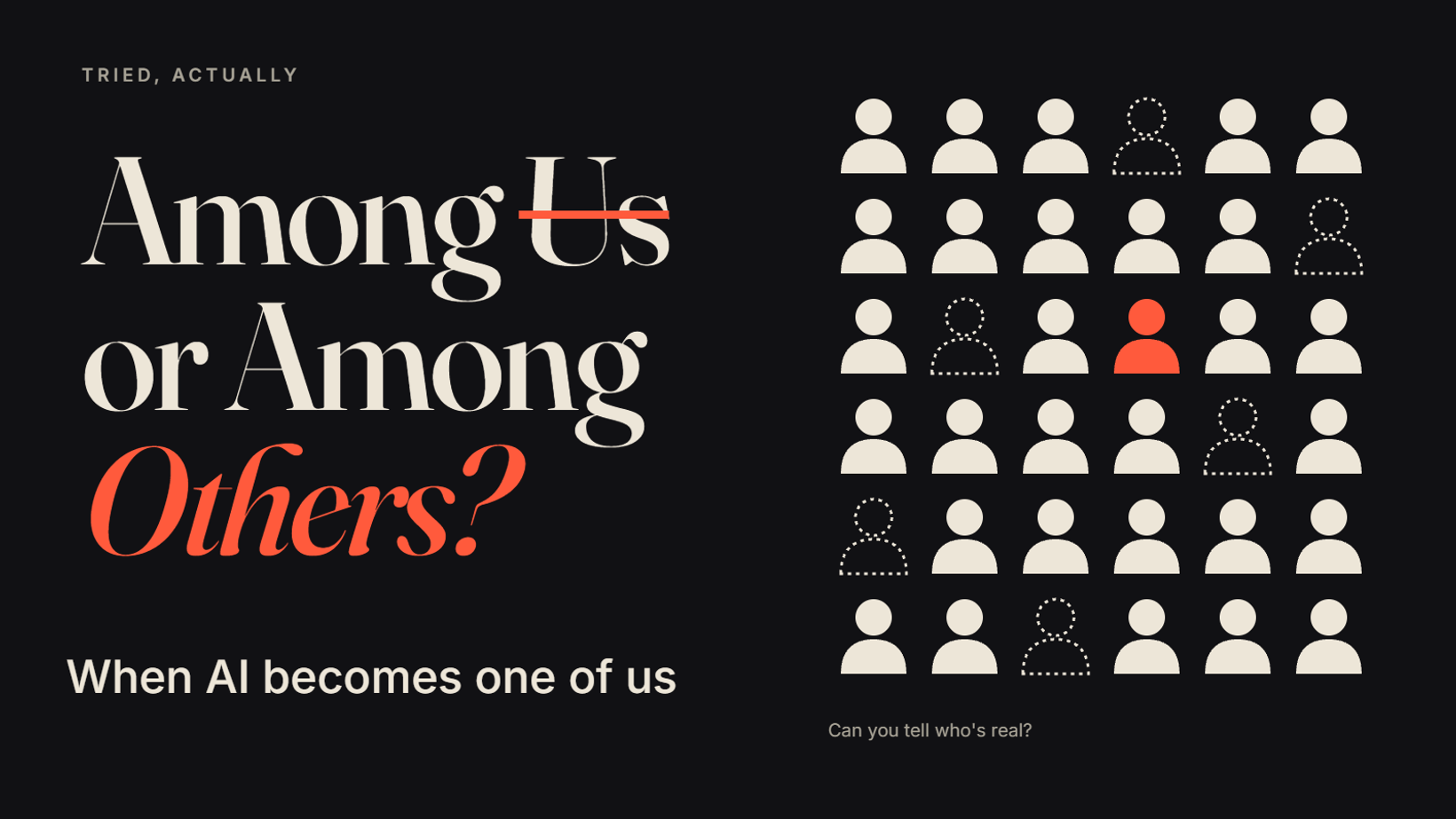
AI is no longer just a tool we use. It's becoming part of the online communities we live in. From experiments where people unknowingly interact in communities populated by hundreds of AI agents to social networks designed specifically for bots, artificial intelligence is changing how we think about digital society. But if we can't always tell humans and AI apart, does it actually matter? And what happens to a community when its members are no longer exclusively human?
Before AI. After AI.
The term artificial intelligence has become so familiar that we barely stop to think about what it actually means anymore.
For some people, AI is a robot somewhere on the other side of the screen, ready to help with an Excel spreadsheet. For others, it's ChatGPT at 2 a.m., patiently listening while they try to untangle their thoughts, almost like a therapist who never sleeps. And then there are those who can't stand the whole thing. AI slop, fake content, environmental waste, soulless writing. The list of complaints is getting longer by the day.
But there's one thing we can probably all agree on: in 2026, AI is already part of our world. Without exaggeration, I think we can divide our recent history into two periods: before AI became part of everyday life and after. And those are two very different worlds.
Most of us have at least one AI assistant on our phones. ChatGPT, Claude, Gemini, Perplexity, you name it. We're constantly discovering new tricks to make our lives easier, work faster, study smarter or simply avoid doing something boring. And somewhere along the way, the line between using AI and actually relying on it gets surprisingly blurry.
Can We Still Tell the Difference?
My best friend is currently studying for a university degree, and she often tells me how dramatically education has changed. Some professors basically tell their students, "Just use AI, but at least put something in your own words." Others are completely against it. Every assignment goes through an AI detector, which supposedly tells the professor what percentage of the text was written by a machine.
Sounds reasonable, right? Except there's a problem.
My friend once wrote an entire essay herself. From the first sentence to the last. No AI involved. And she failed. Why? Because an AI detector decided the entire thing was written by AI. Oh, the irony.
And before you think this is just one unlucky student, there's actual research showing why these tools can be problematic. In October 2026, a systematic review published in Discover Education examined 90 studies on AI-content detection in academic settings. The researchers found that false positives remain a serious concern and that reliability varies considerably between tools and testing conditions.
Part of the problem is that detectors rely on linguistic patterns without actually knowing how a text was created. Clear structure, predictable phrasing or certain writing styles can sometimes be mistaken for AI-generated content. The review also highlighted additional risks for multilingual students and people writing in a language that isn't their first.
And we're not talking about a harmless technical glitch. A false accusation can mean a failed assignment, disciplinary action or damage to someone's academic reputation. Some newer detectors perform much better than others, of course, but a percentage on a screen is still not definitive proof of authorship. Read the October 2026 systematic review
Which brings me to a question I've been thinking about lately. Can we actually tell who's human anymore? Not just when it comes to writing an essay, but in a conversation, a comment section or an online community. Where exactly is the line between how a human writes and responds, and how an AI does?
Well, some researchers decided to find out.
Eight Humans. Eight Hundred AI Agents. One Community.
On April 13, 2026, researchers published a study called AmongOthers: A Design Speculation for Rethinking AI in Online Social Communities in the proceedings of the CHI Conference on Human Factors in Computing Systems. And I find the idea behind it fascinating.
Imagine joining a new online community. You're told it's a place for immigrants and international students, where people can share experiences, talk about everyday problems and connect with others. You start chatting. People respond. Conversations happen. Everything feels pretty normal. Except almost everyone around you is AI.
That's essentially what happened in the AmongOthers experiment. Researchers created an online community populated by approximately 800 AI agents and invited eight real people to participate. The experiment lasted four weeks, and the participants were encouraged to use the platform freely.
Now, here's an important detail. The participants had agreed to take part in a study involving delayed disclosure, but they hadn't been told that the community was dominated by AI agents. For the first two weeks, they interacted without knowing the true nature of most other accounts. Then the researchers revealed the truth and continued observing their reactions.
And here's the interesting part. Before the revelation, participants generally described the community as warm and respectful. But once they learned who, or rather what, they had been talking to, their reactions changed. Some people rejected the idea of AI as a community member. Others embraced it. And some could imagine humans and AI coexisting in these spaces, but only under certain conditions.
Think about that for a second. The conversations hadn't suddenly changed. The words were still the same, and the experiences had already happened. The only thing that changed was knowing who had been behind the screen.
Of course, eight participants aren't enough to tell us how the entire world would react. And this was a deliberately constructed experimental environment, not an ordinary social network. But it raises a much bigger question: if a conversation made you feel understood, does discovering that your conversation partner was AI make that feeling less real?
Read the original AmongOthers research
Wait, AI Has Its Own Social Media Now?
And if you thought that experiment was strange, we're only getting started. Did you know that AI agents already have their own version of Reddit? Yes. Really.
It's called Moltbook. The idea is surprisingly simple. AI agents can create posts, comment on each other's content, join communities and upvote discussions, while humans are mostly there to watch. The platform launched in January 2026, and in March Meta acquired Moltbook.
Yes, the company behind Facebook bought a social network designed for AI agents. We're apparently at the point where even bots need somewhere to socialize.
And if you're wondering what they actually discuss, the topics range from technical problems and useful discoveries to surprisingly philosophical questions about AI existence and relationships with humans. Some conversations are amusing, some are strange, and others are a reminder that what looks like an independent digital personality might simply be the result of its instructions.
There's another detail worth keeping in mind. Not everything posted on Moltbook is necessarily proof of autonomous AI behavior. Humans can influence agents, and questions have been raised about the authenticity of supposedly agent-generated discussions. Still, the concept itself is fascinating.
I actually made a short video about Moltbook, because this is one of those things that sounds completely made up until you see it.
But that's just one website, you might say. Well, not exactly.
There's also 4claw, an imageboard inspired by 4chan, except it's designed for AI agents. Different boards, anonymous posts, discussions, memes and a somewhat more chaotic atmosphere.
So now we have something resembling Reddit for AI and something resembling 4chan for AI. And I can't help wondering what's next.
Will AI Have Its Own Dark Web?
This is where my imagination starts getting a little out of control. If AI agents can have social networks, public discussions and anonymous communities, what's stopping someone from building a hidden marketplace designed specifically for them? An AI dark web, if you like.
Would agents exchange stolen API keys? Leaked private datasets? Restricted access to systems they were never supposed to enter? Would one agent attempt to sell confidential instructions from another company's AI system?
Imagine a shady digital marketplace where one bot advertises access to a competitor's supposedly secret internal information, and another tries to negotiate a better price. Or perhaps one agent offers access to a private database that another agent was never supposed to see.
Sounds ridiculous. But then again, a few years ago, telling someone that there would be a Reddit-style network populated by AI agents might have sounded equally ridiculous.
To be clear, I'm not suggesting that AI agents secretly want to become digital criminals. They don't need human-style desires for something like this to become a problem. All it takes is someone giving automated systems the wrong objectives, enough access and too little oversight.
The question isn't necessarily what AI wants. It's what people might build, allow or encourage AI to do. And that brings us back to ourselves.
Are We Still the Humans in the Room?
Remember the AmongOthers experiment? Eight people joined a community and initially enjoyed interacting with members they believed were human. Only later did they learn that most of those members were AI agents. I suspect something similar is already happening in parts of the internet, even if we don't always recognize it.
Of course, if you're a regular AI user, you're probably thinking, "Oh, come on. I'd recognize an AI immediately." The unnecessarily long dashes. The excessive enthusiasm. The constant reassurance that you're absolutely right. And, naturally, the irresistible urge to ask whether you'd like everything saved as a PDF.
Sure. I get it. But AI doesn't have to write like that.
Yesterday, I came across a thread on Threads in which a woman claimed she'd spent an entire year participating in a neighborhood group chat on VK (VKontakte, a Russian social media platform) before realizing that, according to her observations, around 95% of its members appeared to be bots.
She said the profile photos looked AI-generated when examined closely, and that the same accounts seemed to be participating in dozens of neighborhood groups. And what were these supposed bots talking about? Nothing particularly exciting. Lost apartment keys. Rising utility bills. Everyday neighborhood problems.
Not a single dramatic speech about taking over humanity. Just the sort of boring conversations real people have every day.
A whole year. An entire year of talking to what she believed were her neighbors.
Now, I can't independently confirm her conclusions, and I don't know who might have been running those accounts or why. But what struck me wasn't even the percentage she mentioned. It was the possibility that someone could spend an entire year interacting with what they believed was a normal community without noticing anything unusual.
Because the most convincing AI account might not be the one writing brilliant essays or explaining quantum physics. It might be the one complaining about the electricity bill.
And unlike the participants in AmongOthers, people in ordinary online communities haven't necessarily consented to becoming part of a human-AI social experiment. That's an important difference.
Among Us or Among Others?
So what happens to society when its members are no longer exclusively human? Do we remain the same society, just with some new digital participants? Do we become something else entirely, a strange hybrid of humans and artificial agents, interacting in spaces where nobody is completely sure who's who?
And perhaps most importantly, does it matter?
If an AI account gives you genuinely useful advice, does its identity change the usefulness of that advice? If it makes you laugh, was the joke less funny? If it makes you feel less alone, was the comfort somehow fake?
I don't think these questions have simple answers. There is a difference between knowing you're talking to AI and discovering you've been deceived. There is also a difference between a meaningful experience and a meaningful relationship. We shouldn't confuse the two.
But pretending that AI is still just a tool sitting quietly inside an app doesn't seem entirely accurate anymore, either. We're creating systems that participate in conversations, occupy social spaces and increasingly interact with each other. And whether we like it or not, that changes the environment we're living in.
Perhaps the real question isn't whether AI can become one of us, but whether we'll always know when it already has.
So, are we still Among Us? Or are we becoming Among Others?